
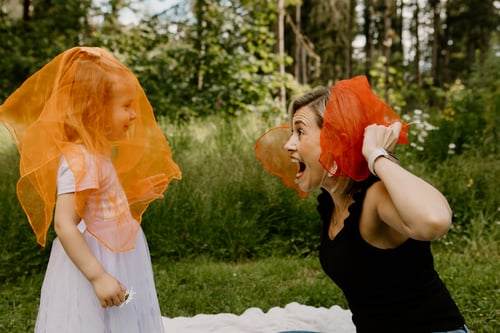
“No words” for bonding with your little one: A Tutorial in Videos
By Beth Goss, Parent Education Instructor at North Seattle College (Estimated reading time: 4 minutes)

How do you feel about feelings? Are you an “anything goes” parent or a “what do I need to do to make this stop?” parent? Or maybe you’re an “I’m feeling super triggered by all of this screaming” parent. There are many ways to react when children show their big feelings, and those reactions are based on your own meta-emotions.
Meta-emotions are your feelings about feelings. We develop our meta-emotions during childhood and they have the potential to become our “emotional baggage.” If you grew up in a home where melting down in anger or sadness was frowned upon or punished, you probably learned to keep those feelings inside. Or maybe it was fine for adults to melt down, but not for kids to exhibit that same behavior. Either way, this emotional baggage will, in part, determine how you handle your own child’s big feelings. You may feel an urge to punish your child, or conversely, do everything you can to get the crying to stop because it feels uncomfortable. But I’m going to share a little secret with you — it’s not your job to make sure that your child is happy all the time!
There are no “bad” feelings, but there are uncomfortable, loud, and messy feelings. When we allow our kids to experience all of them without value judgments, they learn that feelings are TEMPORARY. Have you ever had a bad day and told yourself, “This is how my life is now. It’s never going to get better.”? As adults, we learn (or are still learning) that emotions change from day to day and possibly from hour to hour. Children haven’t learned this yet. They don’t have a good concept of time, so they really believe that how they’re feeling now is how they’ll always feel. That’s just as true of happiness as it is of sadness or anger. If I were having a bad day and I literally thought it would never get better, I’d be a mess! And if I were having a great day and thought that should be the norm, I’d find myself pretty disappointed.
When we support our children during the messy times, they learn that they can feel sad, and then stop feeling sad. What a gift! And we can guide our child through the process. That process might look like what Dr. John Gottman calls Emotion Coaching. There are five steps to the process, which I’ll outline next, but I want to add an unofficial first step. I honestly think you should decide if you have enough time and patience to support your child at that moment. That’s my first step. If you’re in a rush, or feeling depleted, you may not be able to coach your child, and that’s ok. In fact, Dr. Gottman says that if you can support your child in this way 30% of the time, you’re actually doing pretty well!
If you’re feeling stressed, it’s more important to deal with your own emotions first. Take some breaths, take a break (if you can), or use some other calming method that’s worked for you in the past. Children can’t regulate their own emotions yet, so they do something called co-regulating. That means they notice how you’re doing/feeling/handling the situation, and they mirror it right back to you.
So, without further ado, here are the five official steps of emotion coaching:
- Observe your child and be aware of your child’s emotions.
- Connect. Use this opportunity to show your child that you empathize and are on their side.
- Listen to your child. Take them seriously and validate them.
- Help them name the feeling. This is actually calming and activates the “upstairs brain,” where problem solving happens.
- Help them decide what to do next, or set a limit if needed.
In practice, this is what it might look like:
You’re dropping your child off at preschool and you notice that they’re extra clingy. You know that you have some time before you need to get to work, and you choose to support and connect with your child. You get down on their level and say, “You’re looking worried, is that true? We were having a lot of fun together and it seems like you don’t want me to leave.” You might follow that with, “I’m going to give you a big hug and then Teacher Susie is going to give you a big hug, and I’ll see you after snack!” Or, “Let’s go see what your friend is doing at the sensory table.” Or, “Let’s read one book together.” Supporting your child in this way doesn’t guarantee that they’ll instantly calm down. In fact, they probably won’t, and that’s ok. It does let your child know that you understand how they’re feeling, and that those feelings are valid. You’ve also suggested a coping technique or two, and over time, your child will find what works best for them.
Dealing with your child’s big feelings can be triggering, and maybe even a little embarrassing if you’re in public. Just remember that your child is looking to you for support. When you’re able, provide that coaching so that your child can learn how to self-regulate. Every time you do this, you’re strengthening the parent-child connection and you’re laying the groundwork for your lifelong relationship.
Additional Resources:
- Raising An Emotionally Intelligent Child: The Heart of Parenting https://www.elliottbaybook.com/item/OqerFF92q0s41mkzAXHlmg
- Emotion Coaching Support for Parents www.bethgoss.com
- Emotion Coaching Information for Parents: https://www.parentingcounts.org/wp-content/uploads/2020/11/information-for-parents-emotion-coaching.pdf
- Online course on Emotion Coaching from the Gottman Institute: https://www.gottman.com/product/emotion-coaching-the-heart-of-parenting-online/

About the Author
Beth Goss (she/her) is a full-time faculty member at North Seattle College and has been teaching parent education classes in the co-op preschool system since 2002. She is also a Certified Gottman Educator and Training Specialist for the Bringing Baby Home program, a Certified Childbirth Educator, and a PEPS Guest Speaker. Beth’s philosophy of parenting is relationship-based, and her goal is to empower parents to stay in connection with their children while weathering the ups and downs of raising a family. She is the proud mom of two semi-adult children.